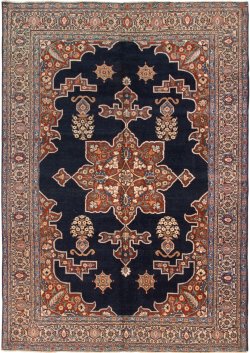
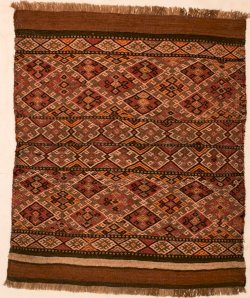
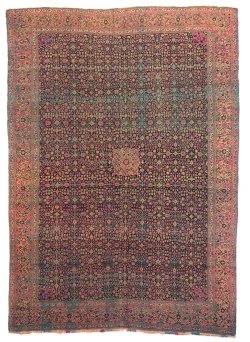
Baotou rug


REF.: R21463
Baotou rug
| Price range: | More than €25.000,00 |
| Description: | Baotou rug |
| Dimensions: | L460xB58 |
| Origin: | China |
| Period: | 1880-1940 |
| Medium: | pile: wool / warp and weft: cotton |
| Technique: | Hand knotted |
Coulours may appear different on the website than in reality. All mentioned prices and sizes are indicative and not binding. Possibly some rugs that are still online, are not available anymore in the showroom.
In the middle of the carpet sits Lao Tse. He was a philosopher in ancient China and is a central figure in Taoism. The ethics of Taosim emphasize three values: mercifulness, moderation and modesty. The creed focuses on health, spontaneity and immortality. Litteraly Lao Tse means ‘old master’ and usually it is considered a title of honor. According to the Chinese tradition Lao Tse lived in the 6th century before Christ. Hij was de master of the ‘Three Pures’ and the head of the eight immortals. In mythic stories he rarely shows up on Earth. Next to him stands a monkey to chase away the evil spirits. The Chinese monkey is a respected animal, very much liked by the people.
The other eight figures are the Taoist immortals. Each figure stands for a Taost doctrine and each of them carries an object to achieve the ultimate goal, namely prolonging life span.
• Chung-li Ch’uan revives the spirits of deceased with his fan
• Lan Ts’ai-ho, also often depicted as a woman, carries a basket with flowers with supernatural powers
• Han Hsian-Tzu performs miracles by playing the flute
• Ho Hsien-ku, the only one always depicted as a woman, carries a lotus flower, symbol for power and purity
• Li T’ieh-kuai carries the rod and gourd of the pilgrim. With the rod he can mutate everything and with the fluids in the gourd he brews medicines
• Lu Tung-pin carries the sword with supernatural powers
• T’sao Kuo-chin provides a relieving and relaxing influence with his bamboo rattle
• Chan Kuo-lao is a magician carrying a bamboo case containing rods with which he predicts faith
We also note four bats. The bat is one of the most frequent occurring animals symbolizing joy and luck. The Chinese pronunciation for joy is fu as it is for the word bat.
The cloud formations are often connected to celestial dragons and are often depicted in combination with flowers or bats as is the case here.
A compound shape symbolizes thunder, something that appears in the earliest forms of Chinese art.
The basic shape of the clouds is the so called linghzi. The linghzi are mushrooms of immortality.
According to the myth, these mushrooms grew abundantly on the Island of the Immortals.
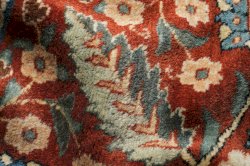
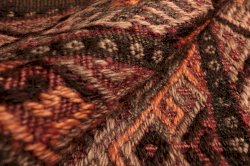
This carpet is knotted with an asymmetrical knot, warp and weft are cotton and pile is wool. The carpet was knotted in the width.
The inscription in the carpet indicates that a certain Qui Lyan made this carpet according to the traditional rules, during the third month of the reign of emperor Tao Kuang (Daoguang) of the Qing dynasty. This means the piece was made in 1821.
Manufacturers and workshops appeared rather late in China compared to Persia, although there definitely must have been a domestic handicraft. Large pieces appeared in the late 17th and beginning 18th century and were (in limited editions) made for temples or palaces.
Around 1900 more big sizes were produced on request of the West. But slowly by slowly, the mass production would put an end to the refinement and subtlety. Fifty years later one can say that the Chinese rug production had completely lost its identity. It had no message to deliver, only technique.
Contemporary production is experiencing new possibilities and mostly follows the expectations of the western market.